
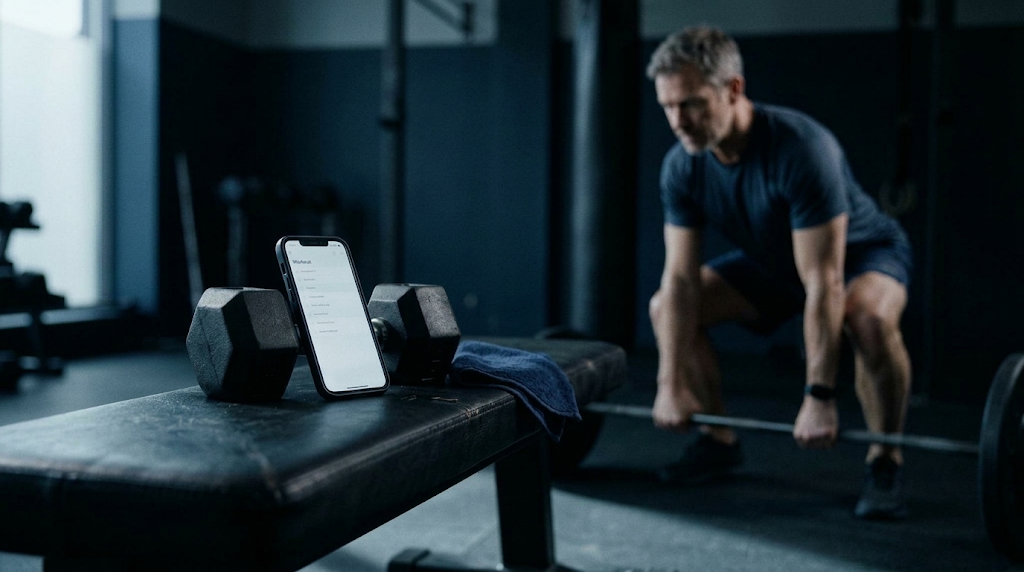
You don't skip workouts because you lack discipline. In a 2025 trial, the group left alone finished half their sessions.
So does online personal training work? I sell it, so read this knowing exactly where my interest sits.
In 2025 researchers finally ran the test I'd want run before anyone spends money on this. They took 79 adults who already trained regularly, split them into three groups, and had every group follow the identical program for ten weeks.
- Group one trained with a coach in the room.
- Group two got online coaching through an app.
- Group three got the plan as a PDF and were left alone.
I'll give you all of it, including the part that doesn't help me sell anything.
The in-person group won
Let me get that out of the way first, because my industry almost never volunteers it.
The supervised group added about 26.6 kilograms to their one-rep max squat. Your one-repetition maximum, written 1RM, is the heaviest load you can lift one time with acceptable technique. The online group added about 19.2 kilograms.
The supervised group was also the only one whose fat-free mass increased by a meaningful amount, and they demonstrated the highest adherence at 88.2% of sessions completed.
If you have the budget, the location, and real control over your calendar, a qualified coach standing beside you is still the best version of this. That's exactly why I still take private clients in Boca Raton.
Now look at what happened to the third group.
The real gap is not online versus in-person
Here's the adherence data — the share of prescribed sessions each group actually completed:
| How they trained | Sessions completed |
|---|---|
| In person with a coach | 88.2% |
| Online coaching through an app | 81.2% |
| Alone, from a written plan | 52.2% |
Read that last row again.
The group left alone skipped nearly half of their prescribed sessions. The program wasn't worse — it was the identical program. The difference was that nobody was checking.
Online coaching landed at 81.2%. That is seven points behind having a coach in the room, and twenty-nine points ahead of doing it alone. On bench press strength, the three groups finished approximately even.
So here's my honest summary: the delivery method isn't the deciding variable. Accountability is.
Most men over 40 are not choosing between in-person and online. They are choosing between online coaching and a program sitting on their phone that they will abandon by week three.
Why a coach in the room still edges it out
Two reasons. Both are worth knowing even if you never hire me or anybody else.
You lift heavier when someone is watching. A study in Medicine and Science in Sports and Exercise put trained men through twelve weeks of the same program. Half of them were supervised and half were not. The supervised group increased the load faster and finished measurably stronger. Identical programming, identical facility, different outcome.
You stop short when nobody counts. Left alone, most people pick a weight they know they can finish. That's entirely human, and it's also the most common reason progress stalls after a few months.
I handle both a different way: a prescribed load you have to report back, and a video of the lift you have to send me. That isn't the same as my hand on the bar. It's considerably closer than most people assume.
What this trial does not prove
I'd rather you trust the next article than oversell this one.
- 79 people over ten weeks. That's a legitimate trial, though not a large one.
- The average age was approximately 31. Not 52. A man in his fifties with a surgically repaired shoulder represents an entirely different problem.
- They were already trained. Beginners tend to improve on almost any reasonable program.
- The online group used an app with a program in it. That is one kind of online coaching. It is not equivalent to a coach who restructures your week when your flight changes.
There's support from a field where the stakes are far higher than a bench press. In cardiac rehabilitation, remotely delivered programs have matched center-based programs when exercise intensity and attendance are equivalent.
That's the fair read. Remote delivery works, supervision works somewhat better, and training alone is where men actually fail.
How I build around that finding
My programming rests on three governing principles. The second and third exist entirely because of the attendance problem above.
1. Progressive Overload, Everywhere. Progressive overload means slowly asking your body to do more than it's used to. Weight, reps, sets, and cardio all climb across the year. You always know the precise number that beats your previous session, which removes guesswork from the variable that actually drives results.
2. Three Weeks On, One Week Down. Each month is three building weeks, then a deload week at 40–60% of the normal workload. A deload is a planned reduction week using the same movements with substantially less accumulated fatigue, so progress compounds instead of stalling.
3. Auto-Regulated, Never Rigid. Autoregulation means the session adjusts to the shape you're genuinely in, not the shape the calendar assumed. Every client of mine runs a readiness check before they start:
| Status | Where you are | What changes |
|---|---|---|
| Green | Slept 7+ hours. Fatigue 4/10 or less. No pain. | Train as written. Push the top of your range. |
| Amber | Slept 5–7 hours. Fatigue 5–6/10. Sore or stressed. | Drop one set from the main lifts. Keep the weight. Skip the grind sets. |
| Red | Slept under 5 hours. Fatigue 7/10 or more. Head cold. | Cut sets by 10–20%. Leave 2–3 reps in the tank. Drop the loads. |
The plan bends to the man rather than breaking him, and that single mechanism separates a program that survives a demanding quarter from one abandoned in week three.
What happens when you travel
Three rules. They're why the men who travel constantly often do better with me online than with a local trainer they can't reach.
Match the pattern, not the exercise. If equipment is unavailable, substitute within the same movement pattern rather than skipping it. A goblet squat and a back squat do the same job.
Recover the load with reps and tempo. Lighter equipment still produces a stimulus. Add repetitions, lower the weight across three or four seconds, pause at the bottom, or reduce your rest intervals.
Progression logic is universal. Adding reps until you hit the top of the range, then adding weight, works with a hotel dumbbell exactly like it works with a barbell.
The research backs the principle. Strength and muscle size can hold for a long stretch on one session a week with one set per exercise, as long as the weight stays heavy.
Where nutrition fits
If I ignored nutrition I'd be leaving most of your result on the table. The guidance itself isn't complicated.
The International Society of Sports Nutrition says 1.4 to 2.0 grams of protein per kilogram of body weight per day is enough for most people who train. For a 200-pound man, that's about 127 to 181 grams. That is achievable entirely through food. Powder is merely convenient.
On body composition, the same organization is blunt: fat loss is driven by a sustained caloric deficit maintained over time. Losing it slower protects more muscle if you're already fairly lean. No arrangement of macronutrients circumvents that.
If you have kidney disease or eat a restricted diet for medical reasons, talk to your doctor or a registered dietitian before you change your protein. That one isn't my call to make.
Coach's Take
In sixteen years of coaching I've watched the same failure repeat over and over, and it has nothing whatsoever to do with online versus in-person.
The men I meet didn't quit because they picked the wrong program. They quit because the program had no version of itself that survives a bad week. A deal closes, a kid gets sick, or two unplanned trips appear. The plan possesses no gear beneath five days a week, so it stops entirely. Six weeks later they start over, a little weaker than last time.
That cycle, repeated through your forties, is what actually costs you.
In-person training buys you a scheduled appointment with somebody who notices you're gone. Good online coaching buys you that same accountability a different way, plus programming that reshapes itself around the month you're actually having.
A PDF buys you a coin flip.
How to tell coaching from a file with a subscription
Ask any coach these five questions before you pay them. Me included.
- 1.Who writes my program, and does it change? If a template adjusts itself automatically, you have purchased software. That's a legitimate product — just don't pay coaching prices for it.
- 2.What happens when I travel? The answer should already exist in documented form, rather than being improvised on the call.
- 3.Do you review my lifts on video? Video review is the single feature that most closely substitutes for a coach in the room.
- 4.How frequently do we speak, and with whom specifically? A weekly check-in with the coach whose name is on the business is a fundamentally different product from a chat queue. When you work with me, you talk to me.
- 5.What do you track, and what will you show me at ninety days? If nobody records your loads, nobody can demonstrate that you progressed.
Vague answers mean you're buying a file, not coaching.
A note on safety
This is general education, not medical advice, and it doesn't replace care from your own clinician. Talk with your physician before you start if you have cardiovascular disease, high blood pressure, diabetes, a recent injury, or a joint replacement. Seek immediate medical attention for chest pain, unusual shortness of breath, dizziness, or fainting.
If you want the version that bends to your month
My online coaching is built around what the research keeps pointing at. Not the delivery method — whether the plan survives the week you're actually having. Programming written for you, video form review, a weekly check-in with me, the readiness system above, and a reduced-equipment version of every session for the road.
Frequently asked questions
Does online personal training work as well as in-person?
Is online coaching better than a program I bought?
Can online coaching work if I travel all the time?
How much protein do I need?
What should online coaching include at minimum?
Sources and further reading
- 1.Gavanda S, Held S, Schrey S, et al. Optimizing Resistance Training Outcomes: Comparing In-Person Supervision, Online Coaching, and Self-Guided Approaches: A Randomized Controlled Trial. Journal of Strength and Conditioning Research 2025;39(11):1129–1137. Link
- 2.Mazzetti SA, Kraemer WJ, Volek JS, et al. The influence of direct supervision of resistance training on strength performance. Medicine and Science in Sports and Exercise 2000;32(6):1175–1184. Link
- 3.Fragala MS, Cadore EL, Dorgo S, et al. Resistance Training for Older Adults: Position Statement From the National Strength and Conditioning Association. Journal of Strength and Conditioning Research 2019;33(8):2019–2052. Link
- 4.Jäger R, Kerksick CM, Campbell BI, et al. International Society of Sports Nutrition Position Stand: protein and exercise. Journal of the International Society of Sports Nutrition 2017;14:20. Link
- 5.Aragon AA, Schoenfeld BJ, Wildman R, et al. International Society of Sports Nutrition Position Stand: diets and body composition. Journal of the International Society of Sports Nutrition 2017;14:16. Link
- 6.Spiering BA, Mujika I, Sharp MA, Foulis SA. Maintaining Physical Performance: The Minimal Dose of Exercise Needed to Preserve Endurance and Strength Over Time. Journal of Strength and Conditioning Research 2021;35(5):1449–1458. Link