
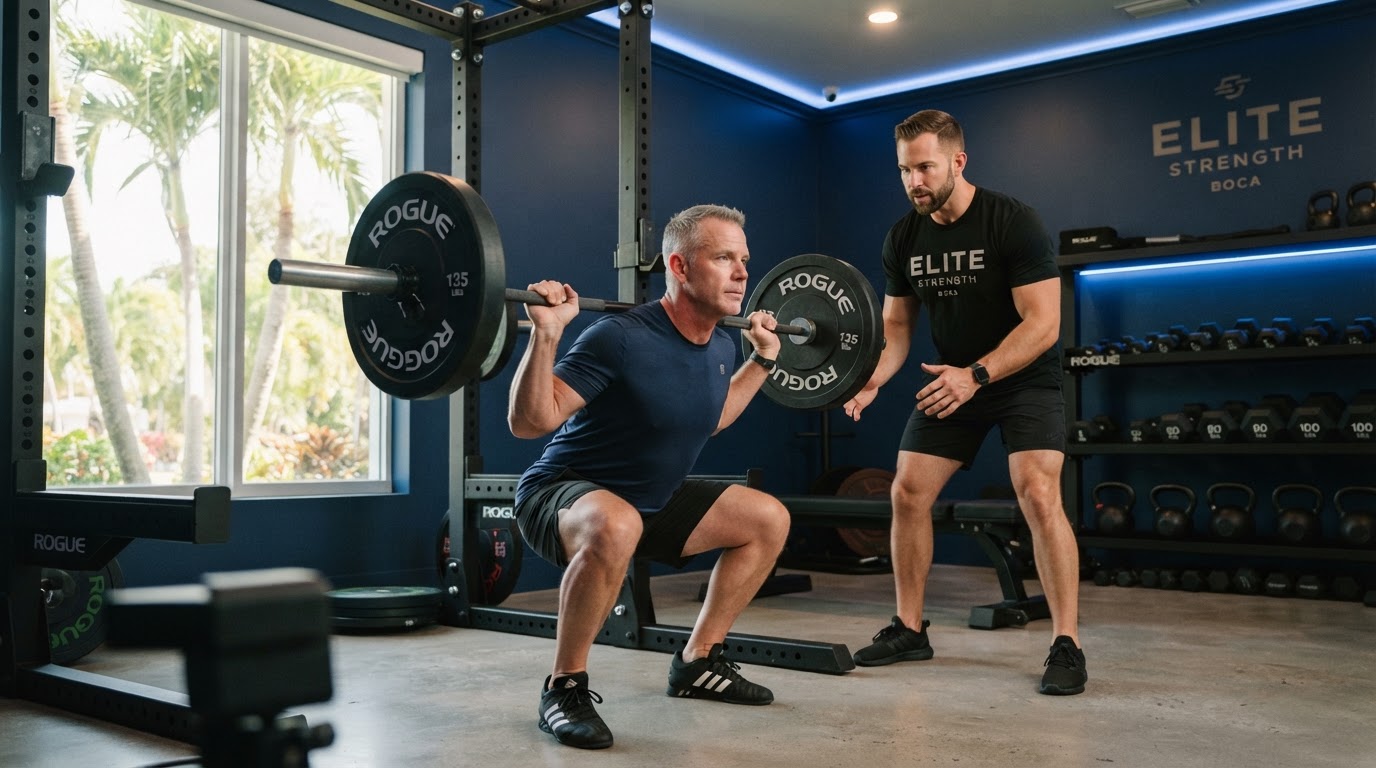
Five trainers on Congress will give you five different answers. Seven questions tell you which one to hire.
Boca Raton has no shortage of personal trainers. That's the problem. Hiring a personal trainer in Boca Raton isn't about finding one. It's about telling them apart.
You can walk into five facilities along Glades or Congress and receive five confident opinions, at advertised rates running anywhere from about $50 to $150 a session. Almost none will produce a credential unless you ask directly, and most will deliver a punishing first session, because exhaustion feels like value even when it teaches nobody anything.
I take private clients here, so I have an obvious stake in how this decision goes. I'm giving you the questions anyway, including the one that should rule me out.
First: is a private trainer even the right buy?
Be honest with yourself before you spend the money.
If you have never trained consistently and primarily need somebody to tell you what to do, a competent online coach or a well-constructed program will take you a considerable distance for a fraction of the price. If you're already disciplined and training, same answer.
Private 1:1 earns the premium in four situations:
- 1.You have an injury history, a surgical repair, or pain that makes you hesitant to load a movement.
- 2.You've trained before and stalled, and you think it's technique.
- 3.Your schedule is unpredictable enough that a fixed appointment with a human being is the only mechanism that reliably works.
- 4.You want the fastest honest rate of progress and you're willing to pay for the final fifteen percent.
That last one isn't salesmanship. Here's the evidence. In a 2025 randomized trial, people coached in person finished 88.2% of their sessions and added about 26.6 kilograms to their squat in ten weeks. A matched group ran the same program alone and finished 52.2% of sessions. Identical programming. Roughly half the attendance.
Earlier research found the reason: supervised lifters put weight on the bar faster and finished measurably stronger for it. My job isn't counting your reps. It's making sure the number climbs.
If none of those four describe you, keep your money. If two or more apply, keep reading.
The seven questions
1. What's your certification, and who accredits it?
The brand of certification matters far less than who stands behind it. Ask if the credential is accredited by the National Commission for Certifying Agencies. NASM, the National Strength and Conditioning Association, and the American College of Sports Medicine all hold accredited certifications. An online weekend course does not.
2. How many clients my age are you training right now?
Not "have you ever." Right now. A trainer whose roster is mostly 24-year-old athletes is genuinely excellent at something that isn't you. Coaching a 52-year-old with a desk job, a repaired shoulder and four flights a month is a different craft. Ask which one they do all day.
3. What does your assessment cover before we load a bar?
A first session should be mostly information gathering: a movement screen, injury history, an honest look at your real week, and baseline numbers. If session one is built to make you sore, neither of you learned a thing.
My own assessment follows the movement prep and quality standards used in the EXOS system. That means I evaluate how well you move through a pattern before adding meaningful load to it.
4. What happens to my program when I travel for two weeks?
This is the question that tells you whether a trainer has actually worked with professionals. The answer should already exist in writing, not get invented in front of you.
The evidence-based answer: you can hold most of your strength on one session a week with one set per exercise, as long as the weight stays heavy. A trainer who tells you a two-week absence means starting over is mistaken, and will waste your first week back on unnecessary work.
The rules I apply are straightforward. Match the pattern, not the exercise — if the gear is missing, swap inside the same movement, don't skip it. Recover the load with reps and tempo — lighter gear still works if you add reps, slow the lowering, or cut rest. Progression logic is universal — the same method works with a hotel dumbbell and a barbell.
5. What are you tracking, and can I see it?
Weights, reps, measurements — whatever fits your goal. Written down, visible to you, and reviewed on a defined schedule. If nobody writes the numbers down, neither of you can prove you got stronger. You'll both be going on feel.
6. What would make you tell me not to train with you?
A trainer with standards has an answer ready. Mine: if you need rehab rather than training, you need a physical therapist first, and I'll tell you that on the call. And if you want a weekly workout partner with no real plan behind it, I'm an expensive way to get one.
7. What does this cost in total for three months?
Not per session. Total. Including anything you're expected to buy on top. I'll give you that number on the first call without flinching, and so should anyone else.
One answer that should rule me out
I said I'd include this one.
If you have an active injury that needs rehab, I'm the wrong first call. See a physician or physical therapist, get cleared, and then a strength coach is worth a great deal to you. In the other order, you're paying me to guess.
Any trainer who claims to do rehab without the right credential is either unusually credentialed or doesn't know where the line is. Ask which.
Coach's Take
Here's what nobody tells you: in a market like this one, the first session is usually built to sell you.
It's an easy trap. A punishing workout makes you sore, soreness feels like proof, and you sign a package. Two months later you're still sore and no measurably stronger, because nobody built you a program. They built you an experience.
A genuinely good first session is almost boring next to that. I ask about your history. I watch you squat, hinge, press and pull with light weight. I find out your left shoulder doesn't rotate like your right. I write down numbers that will matter in twelve weeks.
You leave slightly underwhelmed and a great deal better understood.
The soreness can come in week three, once there's a reason for it.
A note on safety
This is general education, not medical advice. Talk with your physician before you start if you have cardiovascular disease, high blood pressure, diabetes, a recent injury, or a joint replacement. Seek care right away for chest pain, unusual shortness of breath, dizziness, or fainting.
If you want to see what the assessment looks like
I take a deliberately small number of private 1:1 clients in Boca Raton. The first session is the assessment above: movement screening, injury history, a look at your real schedule, and baseline numbers. You'll know by the end whether this is a fit, and I'll tell you straight if it isn't.
Frequently asked questions
How much does a personal trainer cost in Boca Raton?
What certification should a personal trainer have?
Is a personal trainer worth it after 40?
How many days a week should I train with a trainer?
What should happen in a first personal training session?
Sources and further reading
- 1.Gavanda S, Held S, Schrey S, et al. Optimizing Resistance Training Outcomes: Comparing In-Person Supervision, Online Coaching, and Self-Guided Approaches: A Randomized Controlled Trial. Journal of Strength and Conditioning Research 2025;39(11):1129–1137. Link
- 2.Mazzetti SA, Kraemer WJ, Volek JS, et al. The influence of direct supervision of resistance training on strength performance. Medicine and Science in Sports and Exercise 2000;32(6):1175–1184. Link
- 3.Fragala MS, Cadore EL, Dorgo S, et al. Resistance Training for Older Adults: Position Statement From the National Strength and Conditioning Association. Journal of Strength and Conditioning Research 2019;33(8):2019–2052. Link
- 4.Jäger R, Kerksick CM, Campbell BI, et al. International Society of Sports Nutrition Position Stand: protein and exercise. Journal of the International Society of Sports Nutrition 2017;14:20. Link
- 5.Spiering BA, Mujika I, Sharp MA, Foulis SA. Maintaining Physical Performance: The Minimal Dose of Exercise Needed to Preserve Endurance and Strength Over Time. Journal of Strength and Conditioning Research 2021;35(5):1449–1458. Link
- 6.Bull FC, et al. World Health Organization 2020 guidelines on physical activity and sedentary behavior. British Journal of Sports Medicine 2020;54:1451–1462. Link