
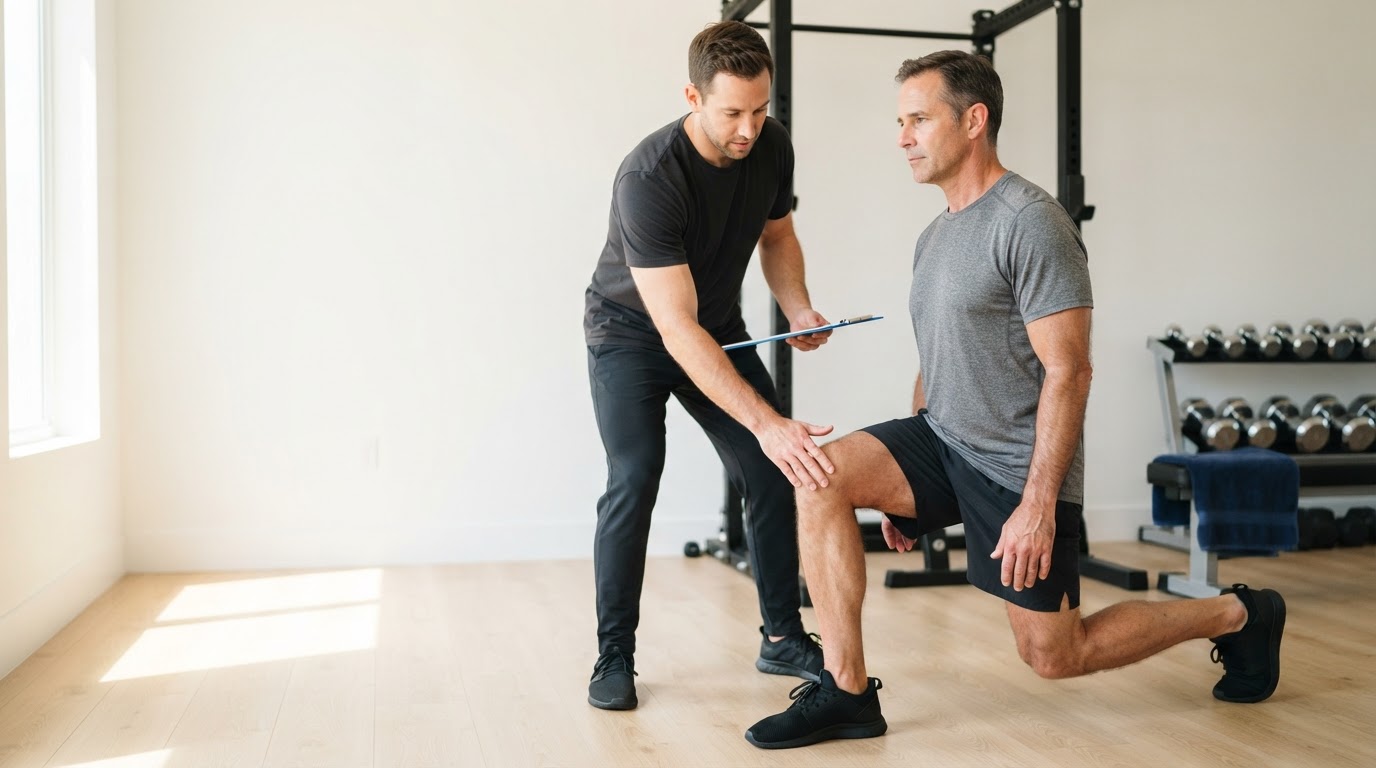
Most men over 45 are carrying two things: an imaging report, and a sentence from a doctor they have quietly turned into a verdict.
Wear and tear.
Degenerative changes.
Consistent with your age.
Here is what the research says about that verdict. In a review of 48 exercise trials in knee osteoarthritis, how severe the joint looked on film did not change how well the program worked — and neither did how much pain the person started with.
Learning how to train around an old injury is not about finding the gentlest possible workout — it is about loading the right thing, on purpose, with somebody watching.
Should you rest an old injury or train it?
For the common wear-and-tear problems in the knee and shoulder, loading the joint is the treatment and waiting it out is what costs you. Guidelines put exercise at the front of the queue, not at the end of it.
The Cochrane review pulled data from 54 studies. Across 44 trials and more than 3,500 people, exercise reduced knee pain by roughly 12 points on a 100-point scale — graded high-quality evidence — and physical function improved on a similar scale.
Twelve points does not sound like a revolution, but set it against the alternative — which for most men is nothing at all — and it is the difference between managing a knee and scheduling your life around it for twenty years.
The shoulder picture looks the same. An umbrella review in the Journal of Orthopaedic & Sports Physical Therapy pulled together 16 systematic reviews on subacromial shoulder pain and issued a strong recommendation for exercise as the first-line treatment for pain, movement and function.
Does how bad it looks on the scan decide your outcome?
Less than almost anyone expects: across that meta-regression of 48 trials, the benefit of a well-built program held up regardless of how severe the joint looked on imaging and regardless of how much pain the person started with.
I want to be careful here, because this is the kind of finding that gets stretched. It does not mean imaging is useless or that structural damage is imaginary — some findings genuinely change the plan and some send you to a surgeon. What it means is narrower and more useful: a grim-looking film is not evidence that training will fail you. Most men read the report and assume the ceiling has been set, when the data says the ceiling is mostly set by what they do next.
Why does focusing on one thing beat doing a bit of everything?
Because scattered programs barely moved the needle, while programs built around one single aim produced an effect roughly four times larger than programs mixing several exercise types together.
Single-type programs came in at 0.61 against 0.16 for mixed ones, and when the target was specific — quadriceps strength rather than general lower-body work — the effect ran 0.85 against 0.39.
This contradicts almost every rehab circuit I have seen handed to a 50-year-old: fifteen minutes of bike, a few band exercises, some balance work, a stretch sequence, a little of everything and enough of nothing. It feels thorough, and it is the version that produced 0.16. So pick the thing that is actually weak, load it properly, and leave the variety for when it is no longer the weak thing.
The machines that don't earn their money
The same shoulder review found no meaningful benefit — at moderate evidence quality — from several treatments men pay for regularly: shockwave, therapeutic ultrasound, low-level laser and pulsed electromagnetic energy.
Manual therapy was supported as a useful addition to exercise. But if you have spent six months on a table under a machine and nobody has progressively loaded the joint, you have been treated without being trained. Those are different things, and only one of them is what the evidence actually supports.
Does having a coach in the room actually change the result?
It did in the data: supervised exercise performed at least three times weekly produced a clearly larger effect than less-supervised programs, 0.68 against 0.41, and pain relief from aerobic work improved as the supervised sessions went up.
That is the most honest argument I can make for private training, and I would rather hand you the number than a slogan. When a joint is involved, three things decide whether a session helps or sets you back: the exact load, the exact range you stop at, and what you do on the morning it feels worse than it did last week. All three are judgment calls, and all three are easier to get right with somebody standing next to you.
This is the one place where hands-on genuinely has an edge. For a healthy 40-year-old, remote coaching and studio coaching land close together — the trial evidence on that is better than most men assume. For a cranky shoulder that behaves differently on Tuesday than it did on Friday, being in the room is worth something real.
So we usually start in the studio here in Boca Raton while we establish what the joint tolerates, then move toward remote or a blend once the pattern is clear and you can run it yourself. Plenty stay on the blend for good: studio when home, remote when not, one program throughout. The remote side is not a lesser tier; it is video calls and filmed lifts, and what you give up is the hand on the bar, which counts for most in exactly this situation and less once the joint has settled.
What changes in the room when something hurts
Three things, specifically.
The entry point moves. If a tendon is irritated, we often start with holds rather than full movement. A crossover study found isometric contractions dropped patellar tendon pain from about 7 out of 10 to near zero immediately afterward. That trial had six participants, all volleyball players, so I am describing a tool I use rather than a law of nature — but it is a useful tool for getting a session started at all.
The progression gets smaller and more frequent. Not the standard jumps, but small, boring, documented increases, so that when something flares we know exactly which variable caused it.
Your bad days get a written plan. Not "listen to your body," which is advice that means nothing at 6 a.m. when the knee is stiff and you have a flight at noon. A specific reduced version, decided in advance.
The scheduling rule is the one I give everybody: plan your training like it's a business meeting. Three supervised sessions a week was the dose in the research, and that only happens if it sits on the calendar with a start time.
Where my job stops
I am a coach, not a clinician — I do not diagnose and I do not treat. If you have not had the thing looked at, get it looked at. If pain wakes you at night, if the joint locks or gives way, if there is swelling that will not settle, or if anything is getting steadily worse, that is a physician and a physical therapist, not a trainer. I work alongside both, and I will ask for their constraints in writing and program inside them.
Where that line sits is something I would make any coach demonstrate, and it is on my list of questions to ask before you sign with anyone.
Coach's Take
The men I see have almost never been told to train. They have been told to be careful, which is not instruction — it is an absence of instruction wearing a responsible face. So they stop squatting and stop pressing overhead. Ten years go by, the knee is no better, and the quadriceps that was supposed to protect it has quietly gone. The injury did some damage; the decade of caution did considerably more.
Twelve transformations are published on this site; a number of them are high-level executives, and more than a few arrived with something that already hurt. Not one got there by being careful — they got there by loading the right tissue on a schedule, with somebody adjusting it every week.
My honest limitation: the research above covers knee osteoarthritis and subacromial shoulder pain, the two things I see most, and it is not a map for every injury. A post-surgical repair, a nerve problem or an inflammatory condition needs different people in the room. The principles hold up broadly; the dosing does not transfer automatically.
Everything here also assumes the training underneath it is sound, which is the four foundations and comes first.
What to do in the next two weeks
- 1.Get a name for it. Train around a diagnosis, never instead of one.
- 2.Pick one target. The specific weak muscle, not a circuit of everything.
- 3.Set three sessions. That was the supervised dose that outperformed. Put real start times on them.
- 4.Write the bad-day version now. Before you need it, not during.
- 5.Log the load every session. When something flares, the log tells you which variable moved.
One safety note
This is education, not medical advice, and it is no substitute for your own clinician. Talk to a physician before starting if your heart, circulation or blood sugar is under treatment, if a joint has been replaced, or if an injury is still recent. Chest pain, breathlessness that surprises you, dizziness or fainting mean stop and get seen the same day. Sharp pain, a joint that buckles, or soreness that climbs across the next few days is information worth handing to a professional rather than training through.
Let's find out what the joint actually tolerates
If you are carrying an old knee or shoulder and the plan so far has been caution, the useful next step is measuring what it can do under load, in person, with someone watching. That is where private training in Boca Raton starts.
Frequently asked questions
Should I rest an old injury or exercise it?
Does a bad MRI or X-ray mean training won't help?
Is a rehab circuit of lots of different exercises a good idea?
Do I need a trainer in the room, or can I do this online?
Do laser, shockwave or ultrasound help shoulder pain?
Sources and further reading
- 1.Fransen M, McConnell S, Harmer AR, Van der Esch M, Simic M, Bennell KL. Exercise for osteoarthritis of the knee. Cochrane Database of Systematic Reviews 2015;1:CD004376. doi:10.1002/14651858.CD004376.pub3 Link
- 2.Juhl C, Christensen R, Roos EM, Zhang W, Lund H. Impact of exercise type and dose on pain and disability in knee osteoarthritis: a systematic review and meta-regression analysis of randomized controlled trials. Arthritis & Rheumatology 2014;66(3):622–636. doi:10.1002/art.38290 Link
- 3.Pieters L, Lewis J, Kuppens K, Jochems J, Bruijstens T, Joossens L, Struyf F. An update of systematic reviews examining the effectiveness of conservative physical therapy interventions for subacromial shoulder pain. Journal of Orthopaedic & Sports Physical Therapy 2020;50(3):131–141. doi:10.2519/jospt.2020.8498 Link
- 4.Rio E, Kidgell D, Purdam C, Gaida J, Moseley GL, Pearce AJ, Cook J. Isometric exercise induces analgesia and reduces inhibition in patellar tendinopathy. British Journal of Sports Medicine 2015;49(19):1277–1283. doi:10.1136/bjsports-2014-094386 Link
- 5.Malliaras P, Barton CJ, Reeves ND, Langberg H. Achilles and patellar tendinopathy loading programmes. Sports Medicine 2013;43(4):267–286. doi:10.1007/s40279-013-0019-z Link (further reading)
- 6.Keogh JWL, Winwood PW. The epidemiology of injuries across the weight-training sports. Sports Medicine 2017;47(3):479–501. doi:10.1007/s40279-016-0575-0 Link (further reading)