
If a trainer told you your movement screen predicts injury risk, they're ahead of the evidence. The British Journal of Sports Medicine says it doesn't.
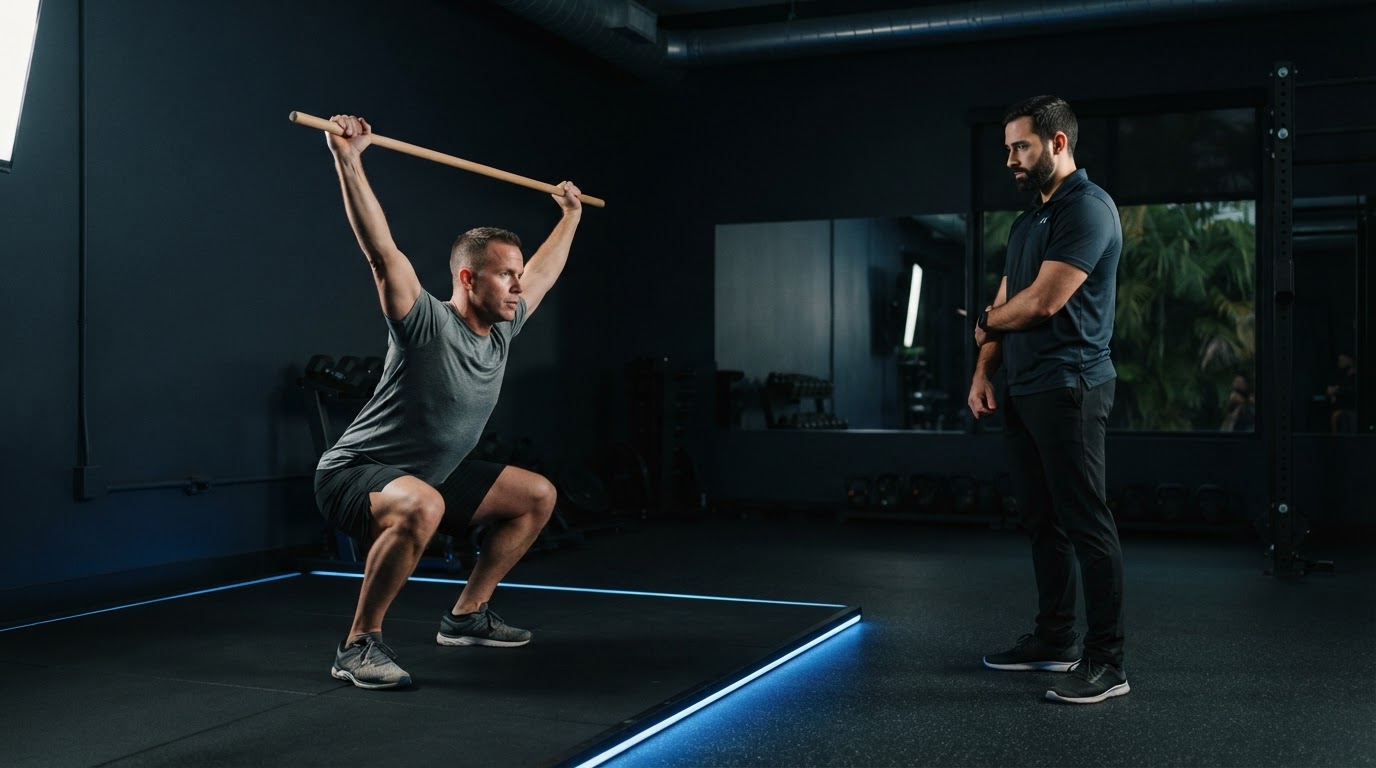
A movement assessment is the first thing I do with every new client in Boca Raton — a screen of how you move through a handful of basic patterns before anything gets loaded. I'm going to tell you what the research says about that, including the part that undercuts how most trainers sell it.
If you're somewhere in your forties or fifties, you've probably already been told you're tight. Tight hips, tight hamstrings, a shoulder that doesn't sit right since whatever happened in 2009. Usually by someone who then sold you a screen to prove it.
Do movement screens predict injury?
The most widely used screen in the industry is the Functional Movement Screen. Seven movements, scored, totaled, and the usual pitch is that a low score flags you as injury-prone so the trainer can fix it before something tears.
A systematic review with meta-analysis published in the British Journal of Sports Medicine examined how strongly those composite scores actually associate with later injury. Its conclusion: the strength of association does not support using it as an injury prediction tool.
A 2025 review in Sports looked at the broader screening landscape — the Functional Movement Screen and the Y-Balance Test together — and reached a similar place. Accuracy in predicting injuries is inconsistent. The overall scores often lack clinical relevance, with wide variation in sensitivity and specificity between groups. The authors point at the reasons: broad scoring systems, context that gets ignored, and screens that don't account for age, sex, fitness level or previous injury.
That last one is the quiet problem. Previous injury is one of the better-established predictors of future injury, and a screen that doesn't ask about it is competing with a question you could answer in ten seconds.
How mixed is the evidence, honestly?
I'm not going to overstate this in the other direction either.
Some reviews report that low composite scores are associated with somewhat higher injury likelihood. The honest summary is that the evidence is mixed, with small associations and wide confidence intervals, inconsistent injury definitions between studies, and poor control for prior injury and training exposure.
So: screens are not useless, and they are not a crystal ball. What they are not is a reliable forecast of who gets hurt. Any trainer who tells you otherwise has read the marketing and not the research.
So why do I still assess every client?
Because prediction was never the useful part. Here's what an assessment actually buys you on day one.
It tells me where to start the load. If you've been at a desk for twenty years and your hip can't extend under its own power, I'm not loading a heavy hinge in week one — and the four things that actually decide your results all get set from that starting point, not from a template. That's not injury prediction — it's exercise selection, and it's the difference between a program built for you and a template with your name typed at the top.
It finds asymmetries worth working around. Your left shoulder doesn't rotate like your right — common in men who've spent two decades with a mouse in one hand. That doesn't mean you'll hurt it. It means the dumbbell press is a better first choice than the barbell, because a barbell forces both sides into the same path and your shoulder will lose that argument.
It gives me a baseline to measure against. In twelve weeks I can show you the same positions and you can see the change. Without a starting point, we're both going on impression.
It surfaces the history. The most valuable part of my assessment isn't a movement at all — it's the fifteen minutes of questions. Old surgeries, the ankle you rolled in college, which positions already bother you, how many nights a month you're in a hotel, and what time you can realistically be here. That conversation changes the program far more than any score does.
It tells me what to refer out. If something in that screen looks like it needs a physician or a physical therapist rather than a coach, you need to hear that in session one, not month three.
So the honest case for assessment is programming, not prophecy.
What should you ask the coach running your assessment?
Four questions. The answers tell you whether they understand their own tool. If you're still comparing trainers, I wrote seven more worth asking before you pay anybody.
- 1."What will you change in my program based on this?" A good answer is specific — exercise swaps, starting loads, range of motion. A vague answer means the screen is theatre.
- 2."Does a low score mean I'll get injured?" If they say yes, they're ahead of the evidence. The answer you want is some version of "no, but it tells me where to start."
- 3."Will you ask about my injury history?" If the assessment is only movements and no conversation, they're skipping the most informative part.
- 4."What would make you send me to a doctor instead?" A coach with standards has a ready answer.
Coach's Take
The screen industry sold a lot of certifications on the promise of injury prediction, and I understand why it caught on. It makes the first session feel clinical. Scores feel like evidence. Handing a client a number feels like value.
What I've found in sixteen years of coaching professionals is that the number is the least useful thing I take away from that session. The useful things are softer and harder to put on a form: watching how you brace when you're unsure, hearing which movement you apologize for before you've done it, noticing that you shift weight off the left leg every time you stand up from the bench.
None of that scores. All of it changes what I write.
And the single most predictive thing I learn is almost never from the movements. It's the answer to "what does a bad week look like for you?" For most of the men I work with here, a bad week means a closing, two flights, and five hours of sleep a night. The program that survives that week is the one that works, and no screen on earth measures it.
What I coach after the assessment
Two things, and they're the same two for every client.
Training, planned like a business meeting. Not aspirationally scheduled. On the calendar, with a start time, treated the way you'd treat a client appointment. That single habit separates the men who change from the men who keep restarting.
Nutrition, kept flexible. I don't hand you a meal plan with two approved dinners. You're going to eat out, you're going to travel, and a plan that can't survive a steakhouse isn't a plan. What I coach is protein targets, hydration, and how to make reasonable decisions in a restaurant — so you're learning to live this way rather than gritting your teeth through it for twelve weeks and then stopping.
I'll write prescribed calorie targets for nobody. That's a registered dietitian's job. Habits and targets I'll coach all day.
When an assessment isn't the right next step
If you have pain right now — not stiffness, pain — a movement screen isn't the appointment you need. See a physician or physical therapist, get it looked at, and then an assessment with a coach is genuinely valuable.
See a clinician first if you have: pain that radiates down an arm or a leg, numbness or tingling, weakness in a limb, pain that wakes you at night, pain following a fall, or any loss of bladder or bowel control, which is an emergency.
A note on safety
This is general education, not medical advice, and it doesn't replace care from your own clinician. Talk with your physician before you start a program if you have cardiovascular disease, high blood pressure, diabetes, a recent injury, or a joint replacement.
If you want to see what mine actually covers
I take a deliberately small number of private 1:1 clients in Boca Raton. The first session is movement, history, a look at your real schedule, and baseline numbers — and I'll tell you straight if what you need is a clinician rather than a coach.
And if you're only here part of the month, say so on the call. In person is the most hands-on version of this, but for men who travel constantly I run a hybrid — in person when you're in town, online with video calls and form analysis when you're not. Same program, same standard of coaching, no gap when you fly out. If you want the evidence behind that, I went through it in does online personal training actually work.
Twelve of my clients have published their results and their own words on my site. Several are high-level executives who were glad to share the outcome but not their title — which tells you something about who this work tends to attract.
Frequently asked questions
Do movement screens predict injuries?
Is a movement assessment worth doing then?
What should a first assessment include?
What is the best predictor of future injury?
Should I get screened if I already have pain?
Sources and further reading
- 1.Moran RW, Schneiders AG, Mason J, Sullivan SJ. Do Functional Movement Screen (FMS) composite scores predict subsequent injury? A systematic review with meta-analysis. British Journal of Sports Medicine 2017;51(23):1661–1669. Link
- 2.Eckart AC, Ghimire PS, Stavitz J, Barry S. Predictive Utility of the Functional Movement Screen and Y-Balance Test: Current Evidence and Future Directions. Sports 2025;13(2):46. Link